Course Introduction
Preface/Abstract
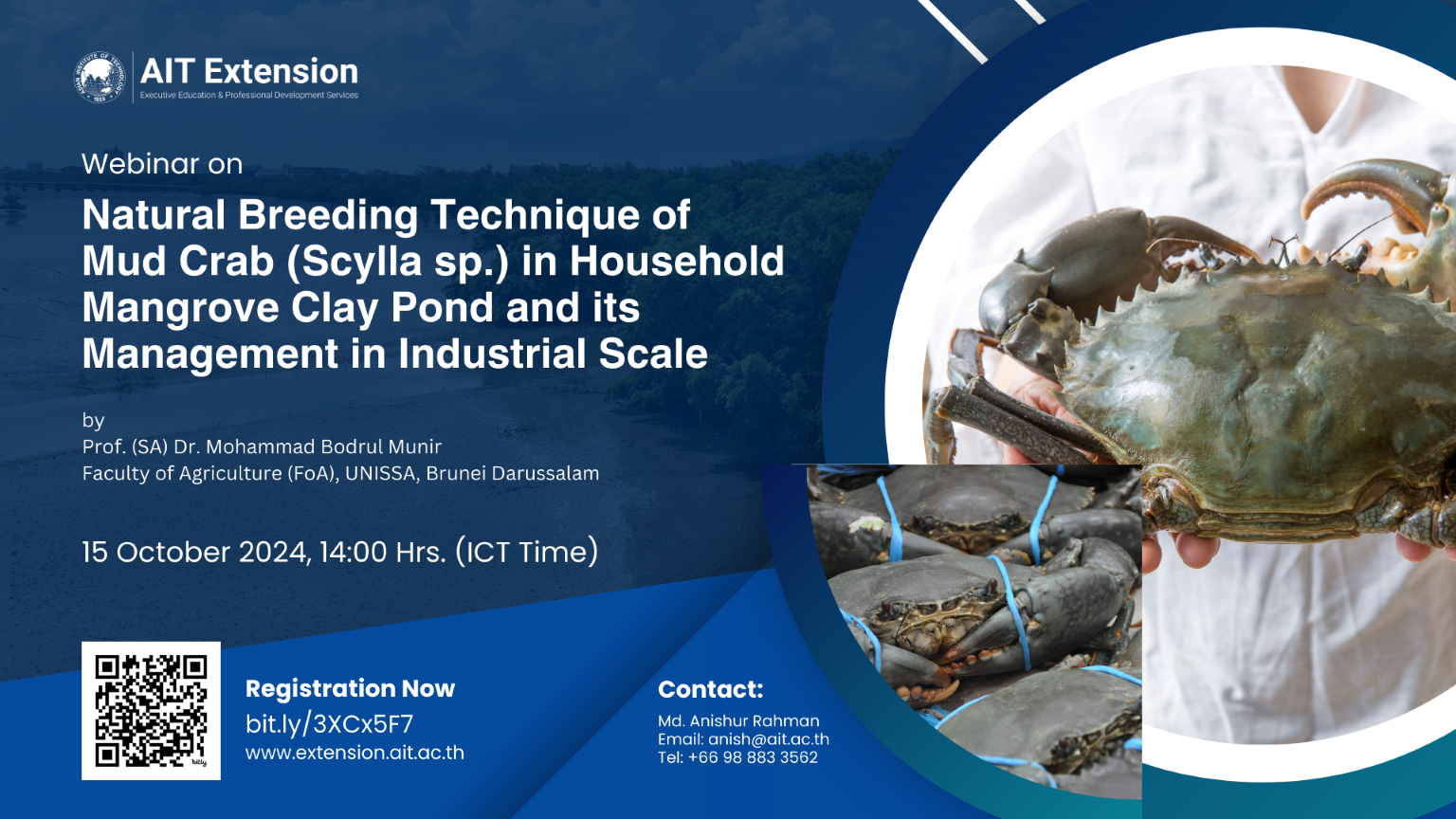
For many countries in South and Southeast Asia, crab is a promising and important export product nowadays. They are also widely distributed and consumed in most of these countries. There are about 4,500 species of crabs worldwide, but the mud crab species (Scylla serrata, S. olivacea, S. paramamosain, and S. tranquebarica) have their high economic importance because of human consumption and export. Furthermore, mud crabs play a very important role in the development of many countries, where they are considered as important food supply source as well as an income income for fishing communities. Incidentally, the warm temperate climate has led to the economic significance of these crabs in south and southeast Asia. Cultivation of mud crab in mangrove areas is very productive, while reducing the pressure of wild harvesting from natural mangrove forest and saving biodiversity losses.
This proposed talk will focus on the sustainable natural method of mud crab seed production in mangrove-based clay ponds. It is a proven new approache which farmers could adopt to boost the positive interactions between their mud crab production and ecology to ensure that their farming systems are economically, and environmentally efficient and sustainable. Moreover, it could guarantee a sustainable income source and achieving food security. The goal of this talk is to extend available knowledge and experiences on the needs to ensure mud crab breeding in household mangrove clay ponds in natural breeding system. This will introduce a nature-based solution (e.g., mangrove based natural crab hatchery) and climate resilient livelihood option found through crab cultivation. Therefore, the environmental risk on natural resources remain limited, and it brings engagement and trust of community, which is fostered to contribute to climate change adaptation and resilience.
Brief Biography of Prof (SA) Dr. Mohammad Bodrul Munir
Prof (SA) Dr. Mohammad Bodrul Munir is presently working in Aquaculture Program under Faculty of Agriculture (FoA) in Universiti Islam Sultan Sharif Ali (UNISSA), Brunei Darussalam. His acdemic career started in Universiti Malaysia Sarawak (UNIMAS) of Malaysia from January 2017, where he continued till June 2023 and moved to Brunei Darussalam in July 2023. He has completed his Ph.D. in Aquatic Animal Nutrition (Dietary Prebiotics and Probiotics) from Universiti Sains Malaysia (USM) on October 2016 and his 2nd M.Sc. degree was from Asian Institute of Technology (AIT), Thailand in the field of Aquaculture and Aquatic Resources Management (AARM) under the School of Environment Resources and Development (SERD) in 2003. Prof. (SA) Dr. Munir previously earned his 1.5 years master’s degree and 4 years B.Sc. (Hons.) degree in Fisheries and Marine Resources Technology (FMRT) from Khulna University, Khulna, Bangladesh. Prof (SA) Munir has worked with many reputed International organizations like DANIDA Technical Assistance Program in Bangladesh; Public Private Partnership (PPP) Aps. in Denmark, The Worldfish in Malaysia etc.
Prof (SA) Dr. Munir’s research interest is on sustainable aquaculture, which include aquaculture, its system and management practices, fish nutriton, immunobiology and post-harvest technology. He has puslished 2 Books, 14 Book Chapters and 53 scientific articles published in different indexed (ISI, SCOPUS, WOS) journals and many training manuals. He has 3 intellectual properties (IP). His first IP “Biogenic Fish Feed” is commercialized by a Malaysian Private Company. Apart from his research works, he has developed two MOOCs for the global aquaculture communities, and has presented the research findings to the global seminars and symposiums.